

Beyond Plastic-Free: What Dental Floss Can Teach Us About Circular Design
TABLE OF CONTENTS
- Executive Summary
- Scope and Limitations
- The Hidden Materials Problem
- What Is Floss Actually Made of?
- When Bio-Based Is Not Necessarily Sustainable
- A Better Framework: Origin → Processing → Use → End of Life
- Silk: From Material to System – History and Relevance to Dental Floss
- Case Study:
8a. The Huzhou Mulberry-Dike Fish-Pond System
8b. The Pearl River Delta System - What “Circular” Really Means
- How Consumers Can Evaluate Dental Floss
- Conclusion: Beyond Material Substitution
LIST OF FIGURES
Figure 1. The Expansion of Plastics: global production, 1950–2019. (Section 3)
Figure 2. From Feedstock to Material: a framework for classifying fiber materials. (Section 4)
Figure 3. Aerial Photograph of the Mulberry-Dike Fish-Pond System: Nanxun District, Huzhou City, Zhejiang Province, China. (Section 6)
Figure 4. Carbon-Cycle Balance: an analogy for understanding carbon flows, regulation, and systemic imbalance. (Section 6b)
Figure 5. Material Origin and Production Pathways. (Section 6c)
Figure 6. The Mulberry-Dike Fish-Pond System. (Section 8a)
Figure 7. From Material to System: a framework for evaluating dental floss. (Section 10)
Figure 8. Beyond Material Substitution: from a linear product model to a circular systems perspective. (Section 11)
REFERENCES
1. Executive Summary
This paper examines dental floss not simply as a material choice, but as an entry point into a larger question: how do carbon, resources, production, consumption, and waste move through the systems that support everyday products?
The sustainability of dental floss may not be defined simply by being “plastic-free,” but by whether the material and product are compatible with a more sustainable overall system. A material should be evaluated according to where its carbon comes from, how it is produced, how it performs, what happens after use, and whether the larger system regenerates resources rather than merely shifting environmental burdens elsewhere.
The problem is not choosing the “best” material. The problem is designing products within systems that can regenerate resources and maintain beneficial carbon, nutrient, water, material, and economic flows.
Author Disclosure
The author sells natural silk dental floss from China. This commercial interest is disclosed so that readers can evaluate the analysis with appropriate context.
2. Scope and Limitations
Scope
This paper examines dental floss as a case study in material and systems thinking. It proposes a framework for evaluating sustainability across material origin, processing, use, end of life, provenance, and the ecological and economic systems in which production occurs. Silk is examined as a case through which this framework can be explored.
This is a systems paper that uses dental floss—and particularly silk and the Huzhou/Pearl River Delta agricultural systems—as a case study. It is not a silk-vs.-nylon paper.
The central question is whether material sustainability can be meaningfully evaluated apart from the agricultural, industrial, ecological, and end-of-life systems through which materials move.
Limitations
This paper does not attempt to determine whether silk, nylon, PTFE, or any other dental-floss material is environmentally superior. It does not present a comparative life-cycle assessment, product-level carbon footprint, or independent assessment of the environmental performance of the author’s product.
The discussion of the Huzhou agricultural system does not establish that the author’s silk participates in that system. Where product-specific provenance or performance has not been independently verified, the paper identifies those limitations rather than treating supplier-reported information as independently established fact.
The Huzhou agricultural system is presented as a historical and ecological case study, not as evidence of the provenance or environmental performance of the author’s product.
3. The Hidden Materials Problem
Petroleum became increasingly important to the U.S. economy during the late nineteenth and twentieth centuries, providing feedstocks and energy for the expansion of modern petrochemical industries.[1] But the production of plastic began to rise dramatically after World War II. The OECD’s first Global Plastics Outlook: Economic Drivers, Environmental Impacts and Policy Options (OECD, 2022), released in February 2022, found that plastics production has increased 230-fold from 2 million tonnes (Mt) in 1950 to 460 Mt in 2019.[2] The United States remains one of the world’s largest generators and consumers of plastic.[3]
Figure 1: The Expansion of Plastics: global production, 1950–2019.

Author’s visualization based on data from Liu, Geyer, and Hu (2024), whose dataset is currently available as a preprint (arXiv, November 2024) and has not yet completed formal peer review; it is cited here for its widely used, transparent material-flow methodology, with the OECD’s published figures serving as the primary data source above.
The American Dental Association (ADA) currently says floss and other interdental cleaners help remove debris and plaque, and that interdental cleaning is an essential part of oral care.[4] So the environmental consequences of “disposable plastic” dental products should not be addressed by discouraging effective oral-hygiene practices. A more productive question is whether the product itself can be redesigned. With the global plastic pollution problem, it may appear that switching materials from plastic to a bio-based alternative could solve the problem. However, changing materials does nothing to alter the disposal habits of consumers.
4. What Is Floss Actually Made of?
Plastic is a generic term for polymeric material that may contain other substances to improve performance or reduce costs.[5] The ADA currently says floss is usually made from nylon filaments or plastic monofilaments, while historically it was made from silk.[6] The difference lies in where those filaments come from and what happens after they are discarded.
Polymers may be natural or synthetic. Natural polymers include proteins such as silk; synthetic polymers include materials such as nylon, polyester, and PTFE. Regenerated cellulose fibers such as viscose, modal, and lyocell are produced by chemically processing cellulose and regenerating it into fibers.[7]
Figure 2. From Feedstock to Material: a framework for classifying fiber materials.
Dimension 1 — Feedstock / Carbon Origin (rows)
Dimension 2 — Material Structure / Production (columns)
| Feedstock / Carbon Origin | Natural | Regenerated Semi-Synthetic | Synthetic |
| Natural / Bio-derived | Silk | Rayon, Lyocell | PLA |
| Fossil | – | – | Nylon, PTFE, Polyester |
| Recycled | varies | varies | varies |
Note: Feedstock origin ≠ material identity ≠ production pathway.
A material can be bio-based/derived and synthetic at the same time. For example, if a product is described as “bamboo charcoal floss,” the consumer may reasonably infer “The floss is made from bamboo.” But there are several entirely different possibilities, which are very different products, ecologically and materially.
A. bamboo-derived fiber is the primary structural fiber.
B. bamboo-derived regenerated cellulose is incorporated into a semi-synthetic fiber.
C. bamboo charcoal is incorporated as a functional additive.
D. bamboo-derived material is present in a coating while the structural carrier is a synthetic or semi-synthetic polymer.
5. When Bio-Based Is Not Necessarily Sustainable
The Conservation–Commerce Tension
Environmental conservation and commercial innovation can ask different questions. Conservation may focus on preserving and regenerating natural systems, while a commercial enterprise must also consider whether an innovation can be developed, differentiated, protected, scaled, and brought to market.[8] Commercial decision-making can prioritize legal defensibility, intellectual-property protection, regulatory compliance, cost, and competitive advantage rather than environmental performance as an independent objective. As a result, commercial demand for renewable feedstocks does not by itself establish environmental benefit. Bamboo provides one example: although it is widely promoted as a renewable and sustainable resource, its environmental performance can vary with cultivation, processing, manufacturing, and end-of-life conditions.[9]
Before going any further, we need a common vocabulary.
Key Definitions
Bio-based: Where the carbon or feedstock originates.
Compostable: Able to break down into usable compost under appropriate composting conditions.
Biodegradable: Able to break down through biological processes.
Recyclable: Capable of being collected, processed, and used as material for another product through an available recycling system.
Sustainable: A broader systems concept involving environmental, economic, and social considerations.
Circular: A system in which materials and resources remain in productive cycles rather than becoming waste.
These definitions are intentionally simplified for readability. Where environmental marketing claims are concerned, however, the FTC applies more specific standards concerning the evidence, conditions, completeness, and timeframe required to substantiate claims such as “compostable,” “biodegradable,” and “recyclable.”[10]
Bio-Based Plastic
Polylactic acid (PLA) illustrates an important distinction: bio-derived carbon does not automatically mean environmentally benign end-of-life. Many PLA products require controlled industrial composting conditions that are unavailable to most consumers.[11][12]
Wrong Environment and Conditions
Biodegradation is condition-dependent. A material may biodegrade under some environmental conditions but persist for much longer under others.
- In Landfills: Landfills generally provide very different conditions from industrial composting, including limited oxygen and restricted moisture and microbial activity. Materials that require aerobic composting conditions may therefore degrade much more slowly or through different pathways in a landfill.
- Industrial vs. Natural: Some bioplastics, including PLA, are designed to biodegrade under controlled industrial composting conditions. Where the required temperature, moisture, microbial activity, oxygen, and residence time are not present, degradation may be substantially slower.
Product Limitations and Misleading Labels
- Missing Timeframes: Biodegradability is not a single universal disposal pathway. The rate and completeness of degradation depend on environmental conditions, including temperature, moisture, oxygen availability, microbial activity and material composition.
- Fragmentation Is Not Biodegradation: A material can physically break into smaller particles without being mineralized into simpler substances.[13]
Even when plastics are successfully collected and sorted, recycled polymers may have properties that differ from virgin material, creating technical and economic challenges for some applications.[14]
The Bottom Line
A material’s technical recyclability does not guarantee that it will actually be collected, sorted, processed, and converted into another product. End-of-life claims therefore need to be evaluated in the context of real-world infrastructure, not merely material properties.
A material can be bio-based without being sustainable; biodegradable without being circular; and recyclable without actually being recycled. “Bio-based” merely tells us something about the origin of a feedstock, but it does not tell us what the final product actually is or how its production affects an ecological system.
6. A Better Framework:
SYSTEM
Origin → Processing → Use → End of Life
↑ ↑ ↑ ↑ ↑ ↑ ↑ ↑ ↑ ↑ ↑ ↑ ↑ ↑ ↑ ↑ ↑ ↑ ↑
Carbon, water, nutrients, materials & value flow through every stage
Figure 3. Aerial Photograph of the Mulberry-Dike Fish-Pond System: Nanxun District, Huzhou City, Zhejiang Province, China.
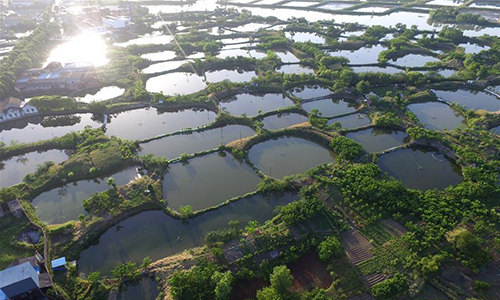
Photograph taken May 13, 2017. Xinhua/Wang Dingchang
6a. Material Origin
Material origin focuses on the feedstock or source from which a material is produced: bio-derived, fossil-derived, or recycled. These categories describe origin, not necessarily the final material’s chemical identity or production pathway. Regenerated cellulose fibers illustrate why processing matters. Viscose (rayon), modal, and lyocell are regenerated cellulose fibers produced from cellulose feedstocks. Lyocell, for example, uses a solvent-based process with high solvent recovery, while conventional viscose production involves different chemical inputs and recovery requirements. The environmental performance of these fibers therefore depends not only on their biological feedstock, but also on feedstock sourcing, chemical management, solvent recovery, energy use, and water use. [15]
6b. Carbon Origin
Carbon origin focuses on the source of the carbon used to build a material or released during its production, use, or disposal. Carbon may be derived from relatively recent biological cycles, such as plants and other living organisms, or from fossil resources whose carbon has been stored underground for geological periods.
The distinction matters because carbon origin does not determine environmental outcome by itself. What matters is how carbon moves through the system: whether it is drawn from active biological cycles, transferred from long-term geological storage, released to the atmosphere, stored in biomass or soils, absorbed by oceans, or otherwise retained or transformed.
The Carbon Cycle: A Personal Analogy
The carbon cycle can feel abstract because most of its processes occur at scales far removed from everyday experience. A useful, though necessarily imperfect, analogy is the human body’s regulation of glucose.
Most people understand that glucose is essential to human metabolism. The problem is not glucose itself; the problem is what happens when the processes that regulate glucose become chronically imbalanced.
Carbon plays a similarly fundamental role in the Earth system. The climate concern is not carbon itself, but the alteration of carbon flows and atmospheric greenhouse-gas concentrations caused by human activity. The critical question is how carbon moves among the atmosphere, living organisms, soils, oceans, geological reservoirs, and human-made products—and whether those flows remain compatible with the capacity of the system to absorb and store carbon over time. [16]
This is an analogy, not a claim that diabetes and climate change are scientifically equivalent. Its purpose is simply to make a complex planetary process more intuitive: a substance can be essential to a system while the rate, pathway, storage, and balance of its movement determine whether that system remains healthy.
Seen this way, the sustainability question is not simply whether a dental-floss material contains carbon or whether its carbon is “bio-based.” The deeper question is where that carbon comes from, how rapidly it moves through the system, how long it remains stored, and what happens to it after the product is used.
Figure 4. Carbon-Cycle Balance: an analogy for understanding carbon flows, regulation, and systemic imbalance.
| Diabetes | Carbon Cycle |
|---|
| Glucose is essential to life | Carbon is essential to life |
| The body regulates blood glucose | Earth systems regulate atmospheric carbon |
| Excessive/chronic glucose load can overwhelm regulation | Excessive/chronic carbon emissions can overwhelm natural sinks |
| Insulin and metabolism maintain balance | Oceans, vegetation, soils, etc. regulate carbon |
| Persistent metabolic imbalance can cause disease | Persistent carbon imbalance increases atmospheric CO₂ and warming |
| The problem isn’t glucose itself | The problem isn’t carbon itself |
| The problem is metabolic imbalance | The problem is carbon-cycle imbalance |
6c. Disposability
Polymer is a broader material category than plastic; not every polymer is a plastic, and the term “plastic” does not by itself identify a polymer’s feedstock or production pathway. [5]
Figure 5. Material Origin and Production Pathways: How feedstock and manufacturing processes produce different material classes.
|
Material |
Feedstock |
Production / Material Type |
|
Silk |
Natural |
Natural protein fiber |
|
Nylon |
Fossil |
Synthetic fiber |
|
Rayon |
Plant Cellulose |
Regenerated fiber |
|
PLA |
Plant-derived |
Synthetic polymer |
These distinctions reveal why material substitution alone is insufficient. Feedstock and production pathway influence the resulting material, and the resulting material influences the end-of-life pathways available to the product. A product’s environmental character therefore depends not only on what it is made from, but also on the flows of carbon, resources, energy, nutrients, and waste through the system that produces, uses, and disposes of it. End-of-life behavior cannot be determined from feedstock origin alone.
7. Silk: From Material to System
History and Relevance to Dental Floss
Silk provides a useful bridge between the material framework developed above and the systems case study that follows. In 1815, dentist Levi Spear Parmly recommended thin silk thread for interdental cleaning. Silk therefore provides a historically established example of a natural fiber being used for the same basic function that modern dental floss serves.[17]
Silk is a natural protein fiber, but the word silk does not tell us enough about finished-product performance or environmental performance. The relevant question becomes: what system produces silk, what flows through that system, and what happens when those flows are designed to reinforce rather than discard one another?
8. Case Study:
8a. The Huzhou Mulberry-Dike Fish-Pond System
For more than 2,500 years, farmers in the low-lying area around Huzhou, Zhejiang, south of Tai Lake, developed a way to turn a difficult wetland environment into a productive agricultural landscape.
[Important Distinction] The system provides a historical example of what circularity can look like at the landscape scale. It should not, however, be interpreted as evidence that every silk product originating in Huzhou participates in the system.
The United Nations Food & Agriculture Organization (FAO) designated it a Globally Important Agricultural Heritage System (GIAHS) in 2017. FAO describes the system as an “eco-cycle” in which resources flow among mulberries, silkworms, fish, and soil, while the water-management system operates at the regional landscape level.[18]
Figure 6. The Mulberry-Dike Fish-Pond System: a circular agricultural network connecting mulberry cultivation, sericulture, aquaculture, soil fertility, and water management.
Nutrients continuously circulate between land, plants, insects, fish, water, and soil rather than being treated as waste at each stage. The system is designed so that outputs from one process can serve as inputs to another:
MULBERRY DIKES
↓ leaves
SILKWORMS
↓ feces
FISH PONDS
↓ nutrient-rich sediment
POND MUD
↓ fertilizer
MULBERRY DIKES
The system is also a water-management and flood-control system. The region is naturally low-lying and historically vulnerable to flooding. Farmers developed a network known as “Zong Pu Heng Tang,” involving rivers, drainage channels, ponds, and raised dikes. Excavated soil was used to build the dikes, while the resulting ponds stored water and reduced flooding. Excess water could then be drained through the interconnected system. Thus, the landscape performs several functions simultaneously:
Flood control + water management + food production + fish farming + silk production + soil fertility + biodiversity.
The Huzhou system is a 2,500-year-old example of designing agriculture as an integrated circular ecological network, where mulberry cultivation, silk production, fish farming, soil fertility, and flood management reinforce one another rather than functioning as separate industries. The system is designed so that the output of one process becomes the input of another.
Threats: The modern Huzhou system is under severe pressure. Research has found substantial changes in land use since 1975, including expansion of fish ponds and construction land, and reductions in mulberry fields and traditional dike-pond landscapes. Thus it is best viewed as a living agricultural heritage system that is being conserved and adapted, not as a perfectly preserved 2,500-year-old system.
8b. The Pearl River Delta Mulberry-Dike Fish-Pond System
Threats: The enormous historical landscape of the Pearl River Delta of Guangdong has been greatly reduced by industrialization and urbanization. Much of the original mulberry–silkworm–fish cycle has disappeared or been converted to other forms of fish farming. Recent research is quite stark: the Pearl River Delta dike–pond system is described as a traditional agricultural heritage that is “on the verge of disappearing” because of socioeconomic development and inappropriate utilization. Another recent study documents the shift from the old integrated landscape toward intensive fish monoculture, abandonment of dikes, and loss of mulberry trees.
Research traced the development of the dike–pond landscape back centuries; mulberries eventually replaced other fruit trees specifically to support silk production, and the system reached a peak around the 1920s. Today, much of the landscape survives only as fishponds alongside industrial and urban development, with little or no silk production remaining.
The Pearl River Delta provides a cautionary counterexample. Historically integrated dike–pond systems have been fragmented by urbanization, industrialization and changes in agricultural economics. The lesson is important: circularity is not a property of a place that persists automatically through time. In the Pearl River Delta, changes in land use, industrial development, government policy, and the economic returns available to farmers have all influenced whether the traditional dike–pond landscape is maintained or converted to other uses. A circular system may therefore be ecologically efficient yet still vulnerable if the economic incentives that sustain its human participants disappear.[19]
9. What “Circular” Really Means
A circular economy keeps materials and products in circulation for as long as possible. The circular economy, when designed in a thoughtful manner, has the potential to protect the environment, improve economics, and elevate communities.[20]
- Environmental: Protecting natural resources, reducing carbon footprints, and minimizing waste.
- Economic: Encouraging economic growth that is viable in the long run without depleting environmental capital.
- Social: Ensuring equitable access to resources, promoting human well-being, and supporting fair labor practices.
One may argue that consuming and then disposing of silk floss maintains a linear consumption-disposal habit, however a refill system can separate the durable component from the consumable component – the dispenser is designed for repeated use, while the floss is replaced as needed. This may not make the entire system circular by itself, but it can reduce the need to replace the durable component each time the consumable is used.
Bio-based describes origin – Biodegradable describes fate – Circular describes a system – Life-cycle connects them.
10. How Consumers Can Evaluate Dental Floss
Consumers are often encouraged to evaluate dental floss according to what it is made from, what coatings or ingredients it contains, and what it does not contain.[21]
When we buy silk, we should be able to ask not only what is it, but where did it come from, who produced it, and what agricultural landscape made it possible? We should also be able to ask what kind of carbon it contains, how each element is processed, how it performs, what happens after disposal, and whether the system supplying it regenerates resources.
Figure 7. From Material to System: a framework for evaluating dental floss across material, provenance, carbon, processing, use, end of life, and ecological context.
| Dimension | Question |
|---|
| Material | What is the fiber actually made from? |
| Provenance | Where was the raw material produced? Can that claim be independently verified? |
| Carbon | Is the carbon fossil or biogenic? |
| Processing | How much chemical/energy was required to produce it? |
| Coating | What is the wax/coating made from? |
| Packaging | Is the dispenser refillable? |
| Use | Does it perform adequately and comfortably? |
| End of life | What actually happens after disposal? |
| System | Does the supply chain support regenerative practices? |
Note: Biodegradability is an end-of-life property. Circularity is a systems property.
11. Conclusion: Beyond Material Substitution
The more useful question is not whether a material comes from plants, animals, or petroleum, but how it performs across its entire life cycle – from raw materials through disposal. Small everyday choices become meaningful when multiplied across millions of households. The future of sustainable dental floss isn’t “plastic-free” – it’s system-compatible!
Figure 8. Beyond Material Substitution: from a linear product model to a circular systems perspective.
From a LINEAR
Resource → Manufacture → Product → Use → Waste
to a SYSTEMS MODEL
Origin → Processing → Use → End of Life
↕↕↕↕↕↕↕↕↕↕↕↕↕↕↕↕↕↕↕↕↕↕↕↕↕↕↕↕↕↕↕↕↕
Carbon ↔ Nutrients ↔ Water ↔ Materials ↔ Economic Value
A material should be evaluated according to: where its carbon comes from → how it is produced → how it performs → what happens after use → and whether the larger system regenerates resources rather than merely shifting environmental burdens elsewhere.
Case Study Disclosure
Huzhou is a case study in ecological circularity—not evidence of the provenance or environmental performance of any particular floss product. The author has attempted to distinguish evidence-supported conclusions from product-specific claims. The academic literature specifically identifies commercialization, changing land use and the loss of multi-functionality as problems for the Pearl River Delta system. Conservation doesn’t necessarily mean preserving an agricultural landscape as a museum piece. The challenge is to make the traditional system economically meaningful to the people who maintain it.
Author and Commercial Disclosures
Contributor Information
Jeffrey Tong is the founder of SINAMARK®, a purveyor of 100% silk dental floss. His work focuses on exploring the intersection of natural materials, dental care, provenance, and circular design. He can be reached at jtong@sinamark.com
Commercial Interest
The author is commercially involved in the sale of natural silk dental floss.
Provenance
The author has not yet established an independently verified farm-to-product provenance chain. The supplier has stated that SINAMARK silk is sourced from Huzhou, but that supplier-reported geographic origin has not yet been independently verified at the farm or cooperative level.
Case Study Independence
The Huzhou mulberry-dike fish-pond system is presented as a historical and ecological case study. Its inclusion does not establish that the author’s silk originates from, or participates in, the traditional system.
Future Work
The author intends to investigate supply-chain provenance, seek farm and cooperative-level documentation, identify potential conservation partners in China, and explore a future Silk Heritage Initiative. Any future “verified-origin” designation would be contingent upon establishing an independently supportable chain of provenance.
LIST OF FIGURES
Figure 1. The Expansion of Plastics: global production, 1950–2019. (Section 3)
Figure 2. From Feedstock to Material: a framework for classifying fiber materials. (Section 4)
Figure 3. Aerial Photograph of the Mulberry-Dike Fish-Pond System: Nanxun District, Huzhou City, Zhejiang Province, China. (Section 6)
Figure 4. Carbon-Cycle Balance: an analogy for understanding carbon flows, regulation, and systemic imbalance. (Section 6b)
Figure 5. Material Origin and Production Pathways. (Section 6c)
Figure 6. The Mulberry-Dike Fish-Pond System. (Section 8a)
Figure 7. From Material to System: a framework for evaluating dental floss. (Section 10)
Figure 8. Beyond Material Substitution: from a linear product model to a circular systems perspective. (Section 11)
REFERENCES
[2] OECD, 2022 Global Plastics Outlook: Economic Drivers, Environmental Impacts, and Policy Options, OECD Publishing, Paris, 06/21/2022, https://doi.org/10.1787/aa1edf33-en.
[3] Cho, Clare Y.; Gatz, Laura; Hammad, Omar M., et al., Plastic Pollution and Policy Considerations: Frequently Asked Questions | Congress.gov | Library of Congress, 03/07/2025
[4] American Dental Association, “Federal Government, ADA Emphasize Importance of Flossing,” ADA News Releases, no. 82, 8/4/2016. https://commons.ada.org/cgi/viewcontent.cgi?article=1081&context=newsreleases.
[6] https://www.ada.org/resources/ada-library/oral-health-topics/floss
[7] Galina Sachanska, et al., Natural and Synthetic Polymers for Biomedical and Environmental Applications – PMC, 04/20/2024;16(8):1159. doi: 10.3390/polym16081159
[8] Constable DJC., What do patents tell us about the implementation of green and sustainable chemistry? ACS Sustain Chem Eng. 2020;8(39):14657-14667. doi:10.1021/acssuschemeng.0c05496.
[9] Himalay R. Patel, et al., Sustainable bamboo: “Technological innovations and patent insights for a greener future,” Advances in Bamboo Science 02/2025, Volume 10, 100127 https://www.sciencedirect.com/science/article/pii/S2773139125000060, https://doi.org/10.1016/j.bamboo.2025.100127
[10] Green Guides | Federal Trade Commission
[11] Frequently Asked Questions about Plastic Recycling and Composting | US EPA, Last updated on 10/31/2025.
[12] “The Life Cycle Assessment for Polylactic Acid (PLA) to Make It a Low-Carbon Material,” Polymers (Basel). 06/02/2021;13(11):1854. doi: 10.3390/polym13111854
[13] Microplastics | Marine Debris Program, Last updated Tue, 02/07/2023
[14] Nisha Singh and Tony Walker, Plastic recycling: A panacea or environmental pollution problem | npj Materials Sustainability, Nature; 08/01/2024. DOI https://doi.org/10.1038/s44296-024-00024-w
[15] Sandra Varnaitė-Žuravliova and Julija Baltušnikaitė-Guzaitienė, “Properties, Production, and Recycling of Regenerated Cellulose Fibers: Special Medical Applications,” J Funct Biomater; 2024 Nov 16;15(11):348. doi: 10.3390/jfb15110348
[16] Chapter 5: Global Carbon and other Biogeochemical Cycles and Feedbacks; IPCC Sixth Assessment Report, Working Group 1: The Physical Science Basis,
[17] Sanoudos, M.; Christen, A. G. Levi Spear Parmly: the apostle of dental hygiene. Journal of the History of Dentistry. 47 (1): 3–6. PMID 10686903, 1999
Note: Some secondary sources date Parmly’s recommendation of silk thread to 1815, when he is believed to have begun advising patients directly. His published account appears in A Practical Guide to the Management of the Teeth (1819). Both dates appear in the dental-history literature; this paper follows the more commonly cited 1819 publication date where precision matters.
[18] Zhejiang Huzhou Mulberry-dyke & Fish-pond System Food and Agriculture Organization of the UN. (FAO UN), 2017.
[19] Wenxin Zhang, “Spatiotemporal Changes in Mulberry-Dyke-Fish Ponds in the Guangdong-Hong Kong-Macao Greater Bay Area over the Past 40 Years,” 10/20/2021, https://doi.org/10.3390/w13212953
[20] https://www.epa.gov/circulareconomy/what-circular-economy
[21] Sydney Cook, “How to Choose Dental Floss Without PFAS and Other Harmful Chemicals,” Consumer Reports, updated 01/18/2025, https://www.consumerreports.org/toxic-chemicals-substances/dental-floss-without-pfas-and-other-harmful-chemicals-a9722832754/.